Vienna
Top attractions and things to do in Vienna
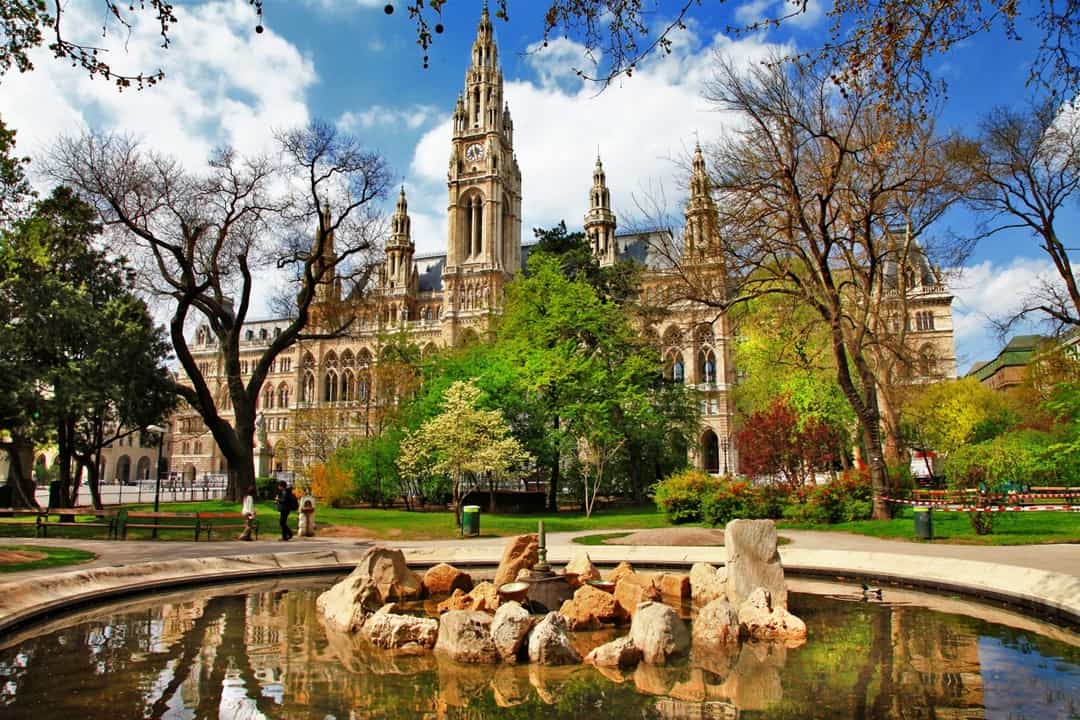
Vienna is the imperial capital of Austria and one of the great cities of Europe, shaped over centuries by the Habsburg dynasty into a place of extraordinary palaces, monumental museums, and a refined cultural life that continues to set the standard for the continent. The city's coffee house tradition - unhurried, civilised, and unchanged in essence since the 17th century - has been recognised by UNESCO as an Intangible Cultural Heritage of Humanity. Add to this a musical legacy stretching from Mozart, Haydn, and Beethoven to Brahms, Schubert, and Mahler, a ring road of magnificent 19th-century public buildings, and one of the most enjoyable city centres in Europe to simply walk through, and Vienna makes a powerful case for a visit at any time of year.
Schönbrunn Palace
The summer residence of the Habsburg emperors and empresses, Schönbrunn is one of the most spectacular palace complexes in the world and the most visited attraction in Austria. The palace itself has 1,441 rooms, of which 45 are open to the public, and the state apartments and imperial rooms reflect the enormous wealth and cultural ambition of the Habsburg court at the height of its power. The vast formal gardens that stretch behind the palace are free to enter and are the ideal place to appreciate the scale of the complex. At the far end of the main axis, a long walk uphill from the palace, stands the Gloriette - a triumphal colonnade built to commemorate the Habsburg victory at the Battle of Kolin in 1757, with a cafe inside and views across the city from the terrace. Within the gardens you will also find the world's oldest zoo, the Tiergarten Schönbrunn, founded as an imperial menagerie in 1752 and now a world leader in conservation and breeding programmes.
Hofburg Imperial Palace
For over six centuries the Hofburg was the seat of the Habsburg dynasty and the heart of the Habsburg Empire. Today it houses the official offices of the Austrian president, as well as a remarkable collection of museums and state rooms open to the public. The complex is vast - the result of successive rulers each adding new wings and courtyards across the centuries - and could absorb a full day of exploration without difficulty. The Imperial Apartments give access to the private rooms of Emperor Franz Joseph I and Empress Elisabeth, known as Sisi, and the Sisi Museum within them contains an extensive collection of personal objects, paintings, and reconstructed spaces that bring her story to life in compelling detail. The Imperial Treasury holds what is arguably the finest collection of imperial regalia in the world, including the Habsburg crown jewels and the lance traditionally believed to be the Holy Lance of Longinus. The Spanish Riding School, housed in the Baroque Winter Riding School within the complex, offers performances of classical horsemanship by Lipizzaner stallions that have been a feature of Vienna since the 16th century.
Belvedere Palace
Built in the early 18th century as the summer residence of Prince Eugene of Savoy, the Belvedere complex comprises two Baroque palaces - the Upper and Lower Belvedere - separated by formal gardens. The Upper Belvedere, completed in 1723, is widely considered one of the finest examples of Baroque architecture in the world, its symmetrical facades and ornate state rooms combining a grandeur that can match the great palaces of France and Germany. The Upper Belvedere now houses the Österreichische Galerie Belvedere, one of Austria's most important art museums. The collection's most celebrated work is Gustav Klimt's The Kiss, painted in 1907-08 and arguably the most recognisable painting to have come out of Vienna's extraordinary fin-de-siècle art scene. The Secession movement, of which Klimt was a central figure, is represented throughout the collection, alongside works by Egon Schiele and Oskar Kokoschka.
St. Stephen's Cathedral
Standing at the geographical and spiritual heart of Vienna, St. Stephen's Cathedral - the Stephansdom - is the mother church of the Archdiocese of Vienna and one of the most important Gothic buildings in the German-speaking world. A cathedral has stood on this site since the 12th century, though the building seen today dates largely from a major rebuilding between the 14th and early 16th centuries. The cathedral's most distinctive feature is its South Tower, nicknamed Steffl (Little Stephen), which rises to 136 metres and was, at its completion in 1433, the second-tallest structure in the world. The climb to the viewing platform is rewarded with an extraordinary view across Vienna's rooftops. The multi-coloured zigzag tile roof of the nave, laid out in a chevron pattern and incorporating the double eagle of the Habsburgs and the city coat of arms, is best appreciated from above. The cathedral's catacombs beneath the nave contain the remains of generations of Habsburg rulers, including the internal organs of all emperors from 1634 onwards - a distinctly Viennese quirk of royal burial custom.
MuseumsQuartier
One of the largest cultural complexes in the world, the MuseumsQuartier (or MQ) occupies the former Imperial Court Stables just beyond the Ring Road near the Mariahilfer Strasse. The complex brings together a remarkable concentration of museums and cultural institutions within a sequence of historic and contemporary buildings, and its large central courtyards - furnished with distinctive loungers and seating installations every summer - have become a social hub for the city. The two anchor institutions are the Leopold Museum, home to the world's largest collection of Egon Schiele's work and an outstanding holding of Viennese Modernism, and MUMOK, the Museum of Modern Art Ludwig Foundation Vienna, whose collection spans Pop Art, Fluxus, Nouveau Réalisme, and Viennese Actionism. The Kunsthalle Wien, the Architecture Centre Vienna, and the children's museum Zoom add further breadth to what is already a very substantial offering. A single day is unlikely to be enough to do justice to the whole complex.
Vienna State Opera
The Wiener Staatsoper is one of the world's leading opera houses and a building of real magnificence, completed in 1869 as one of the first major projects along the newly constructed Ringstraße. The building was badly damaged in the final days of the Second World War and rebuilt in the early 1950s, with the auditorium restored in its original style, though the entrance foyer and grand staircase, which survived the bombing, retain their original 19th-century character. The opera house stages around 50 different productions each year across a season running from September to June, with performances on nearly every evening. Standing-room tickets are sold at very low prices from the box office, making it possible to experience one of the world's great opera stages without significant expense. Even if opera is not your primary interest, a guided tour of the building - available most afternoons - is a worthwhile hour in one of Vienna's most architecturally impressive spaces.
Prater & Riesenrad
The Prater is Vienna's great public park, a large area of former imperial hunting grounds on the east side of the city that was opened to the public by Emperor Joseph II in 1766. Within the park, the Wurstelprater - Vienna's traditional funfair - has been operating in various forms since the 18th century, and its combination of old-fashioned rides, shooting galleries, and food stalls gives it a character quite different from a modern theme park. At the entrance to the funfair stands the Riesenrad, the Viennese giant ferris wheel that has been part of the city skyline since 1897. Built to mark the Golden Jubilee of Emperor Franz Joseph I, the wheel stands nearly 65 metres high and its 15 remaining gondolas - each of which can hold up to 12 people - rotate slowly above the park, offering excellent views across Vienna. The Riesenrad survived both world wars and a demolition order (abandoned for lack of funds in 1916) to become one of the most enduring symbols of the city.
Hundertwasser House
In a residential street in the Landstrasse district stands one of Vienna's most distinctive buildings, a colourful and unconventional apartment block designed by the Austrian artist Friedensreich Hundertwasser and completed in 1986. Hundertwasser spent much of his career advocating for an architecture that worked in harmony with nature rather than against it, and the house is the fullest expression of those ideas: no two windows are the same, the facade is painted in patches of red, gold, and blue, trees grow from the balconies and through the roof, and the floors are deliberately uneven - Hundertwasser famously considered flat floors a form of tyranny. The building remains a privately occupied residential block, so the interior is not open to visitors, but the exterior draws a steady stream of admirers. The Hundertwasser Village, a purpose-built shopping complex directly opposite, is designed in the same style and gives a sense of the interior spaces, as well as housing a permanent collection of Hundertwasser's graphic work and paintings.