Prague
Top attractions and things to do in Prague
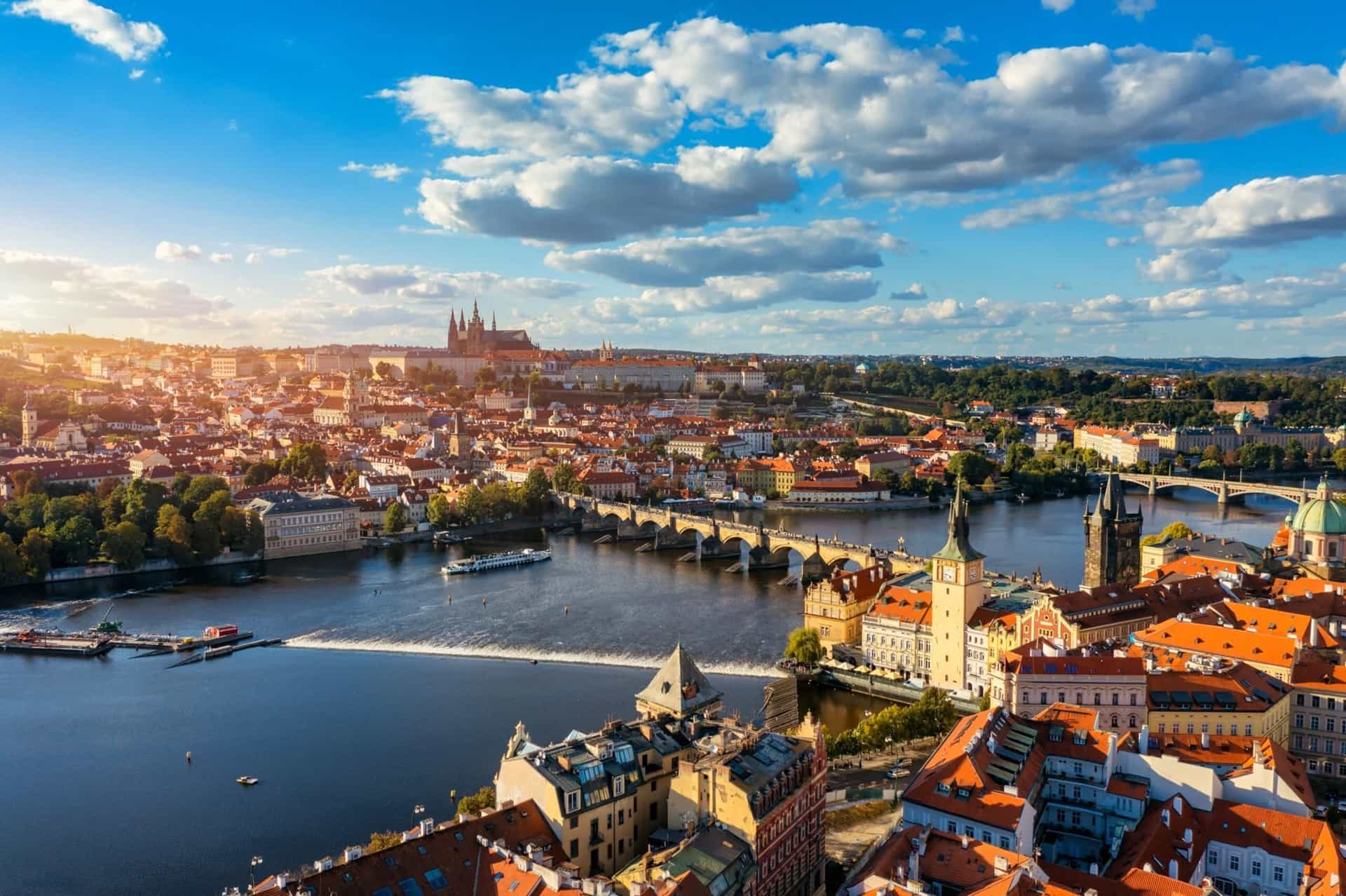
Prague is one of Europe's most extraordinarily preserved medieval cities, a UNESCO World Heritage-listed old town of cobbled lanes, Gothic towers, and Baroque churches spread across seven hills on both banks of the Vltava River. The Czech capital largely escaped the destruction of the Second World War, leaving its historic centre almost entirely intact, and the result is a city that feels genuinely ancient in a way that few others can match. Whether you are crossing the Charles Bridge at dawn or watching the Astronomical Clock perform its hourly display, Prague has a quality that is difficult to shake - and even harder to leave.
Prague Castle
Any visit to Prague begins at Prague Castle, the vast complex of palaces, churches, gardens, and galleries that sits on the western bank of the Vltava and dominates the city skyline. Recognised by the Guinness World Records as the largest ancient castle complex in the world, the site covers nearly 70,000 square metres, and its history stretches back to around 870 AD, when the first wooden fortifications were built on the hill. Within the castle grounds you will find St. Vitus Cathedral, the Old Royal Palace, St. George's Basilica, and the Golden Lane - a colourful row of tiny cottages built into the castle ramparts in the 16th century for castle guards and later for goldsmiths. The changing of the guard takes place every hour on the hour, with a more elaborate ceremony at noon. The views across Prague's rooftops from the castle terraces are among the finest in the city, best enjoyed on a clear morning before the main crowds arrive.
Charles Bridge
Spanning the Vltava between the Old Town and the Lesser Town, the Charles Bridge is one of the great medieval bridges of Europe. Construction began in 1357 under King Charles IV, and for nearly five centuries it was the only bridge across the river in Prague. The bridge is 516 metres long and lined along both sides by a procession of 30 Baroque statues of saints, erected between 1683 and 1714, which give the crossing a remarkably theatrical quality. The Old Town Bridge Tower at the eastern end is considered one of the finest examples of Gothic civil architecture in Central Europe, and climbing to the top offers excellent views along the bridge and across to the castle. The bridge is a pedestrian zone and is busiest in the middle of the day - arriving early in the morning, before the tour groups appear, gives a very different and altogether more atmospheric experience.
Old Town Square & Astronomical Clock
The Old Town Square is the historic heart of Prague, a large and beautiful cobbled space ringed by Gothic towers, Baroque palaces, and colourful Renaissance townhouses. At its centre stands the Memorial to Jan Hus, the Czech religious reformer burned at the stake in 1415, whose story is still a central part of Czech national identity. On the southern wall of the Old Town Hall stands the Astronomical Clock (Orloj), built in 1410 and one of the oldest functioning astronomical clocks in the world. Every hour on the hour, a mechanical procession of the Twelve Apostles emerges from windows above the clock face, accompanied by figures representing Death, Vanity, Greed, and a Turk - all set in motion by a skeleton pulling a bell rope. The performance is brief but genuinely impressive, and the clock itself is a remarkable piece of medieval engineering, simultaneously displaying the time, the position of the sun and moon, and the signs of the zodiac.
St. Vitus Cathedral
The centrepiece of Prague Castle and the seat of the Archbishop of Prague, St. Vitus Cathedral is a Gothic masterpiece that took nearly 600 years to complete, with construction beginning in 1344 and the building only officially consecrated in 1929. From outside, the west facade - a riot of Gothic pinnacles, flying buttresses, and ornate carvings - is remarkable; inside, the vaulted nave soars to 33 metres and the stained glass windows, designed in the early 20th century by several prominent Czech artists including Alfons Mucha, bathe the interior in coloured light. The cathedral holds the tombs of several Bohemian kings and Holy Roman Emperors, including Charles IV, as well as the tomb of St. Wenceslas - the patron saint of Bohemia - in the richly decorated Wenceslas Chapel. The Bohemian Crown Jewels are kept in a chamber above the chapel, though they are only displayed to the public on rare occasions.
Jewish Quarter (Josefov)
The Jewish Quarter, or Josefov, lies just north of the Old Town Square and contains one of the best-preserved historic Jewish neighbourhoods in Europe. Jews have lived in Prague since at least the 13th century, and despite repeated persecution throughout the medieval and early modern periods, the community built an extraordinary concentration of synagogues and communal buildings within this small area. Six historic synagogues survive, the oldest of which - the Old-New Synagogue - has been in continuous use since 1270, making it one of the oldest functioning synagogues in the world. The Pinkas Synagogue serves as a memorial to the approximately 80,000 Bohemian and Moravian Jews murdered during the Holocaust, its walls inscribed with their names. The Old Jewish Cemetery, where graves are stacked up to 12 layers deep due to the shortage of space in the ghetto, is one of the most poignant sites in the city.
Wenceslas Square
Despite the name, Wenceslas Square is less a square and more a broad boulevard, about 750 metres long and lined with hotels, shops, theatres, and restaurants. The equestrian statue of St. Wenceslas, the 10th-century patron saint of Bohemia, stands at the upper end in front of the imposing Neo-Renaissance National Museum. Though the museum's building is now the better-known landmark, the square itself has been the stage for some of the defining moments of modern Czech history - it was here that the proclamation of Czechoslovak independence was made in 1918, and here that the Velvet Revolution began in 1989. The square sits in the New Town district, which despite its name dates largely from the 14th century, and is conveniently close to many of Prague's major sights. The lower end connects to the Old Town, making it a natural route between the two neighbourhoods.
Dancing House
At a bend in the Vltava embankment south of the Old Town stands the Dancing House, one of the most discussed buildings in Prague. Designed by the architects Frank Gehry and Vlado Milunić and completed in 1996, the building's two towers appear to be in motion - one glass and curved, leaning outward; the other cylindrical and rigid - prompting the nicknames Fred and Ginger, after the Hollywood dance partnership of Fred Astaire and Ginger Rogers. It was controversial when it was built, with many critics arguing that the expressionist style was out of place among the Neo-Gothic and Art Nouveau buildings that line the embankment. Over time opinion has softened considerably, and the building is now a well-liked part of the city's architectural fabric. The rooftop restaurant and bar on the 8th floor offers one of the more unusual viewpoints over the city.
St. Nicholas Church, Malá Strana
Not to be confused with the similarly named church on the Old Town Square, this St. Nicholas Church sits in the heart of the Lesser Town (Malá Strana) at the foot of the slope leading up to Prague Castle. Built between 1704 and 1755 to designs by the father-and-son architect duo Christoph and Kilian Ignaz Dientzenhofer, it is widely considered one of the finest Baroque churches in Central Europe. The interior is extraordinary - an overwhelming display of gilded plasterwork, ceiling frescoes, polished marble, and sculpted figures that fills the space from floor to dome. The dome itself soars to 49 metres, painted with scenes from the life of St. Nicholas by Johann Lukas Kracker. The church's pipe organ has 4,000 pipes, and was famously played by Wolfgang Amadeus Mozart during his visits to Prague in the late 18th century.