Munich
Top attractions and things to do in Munich
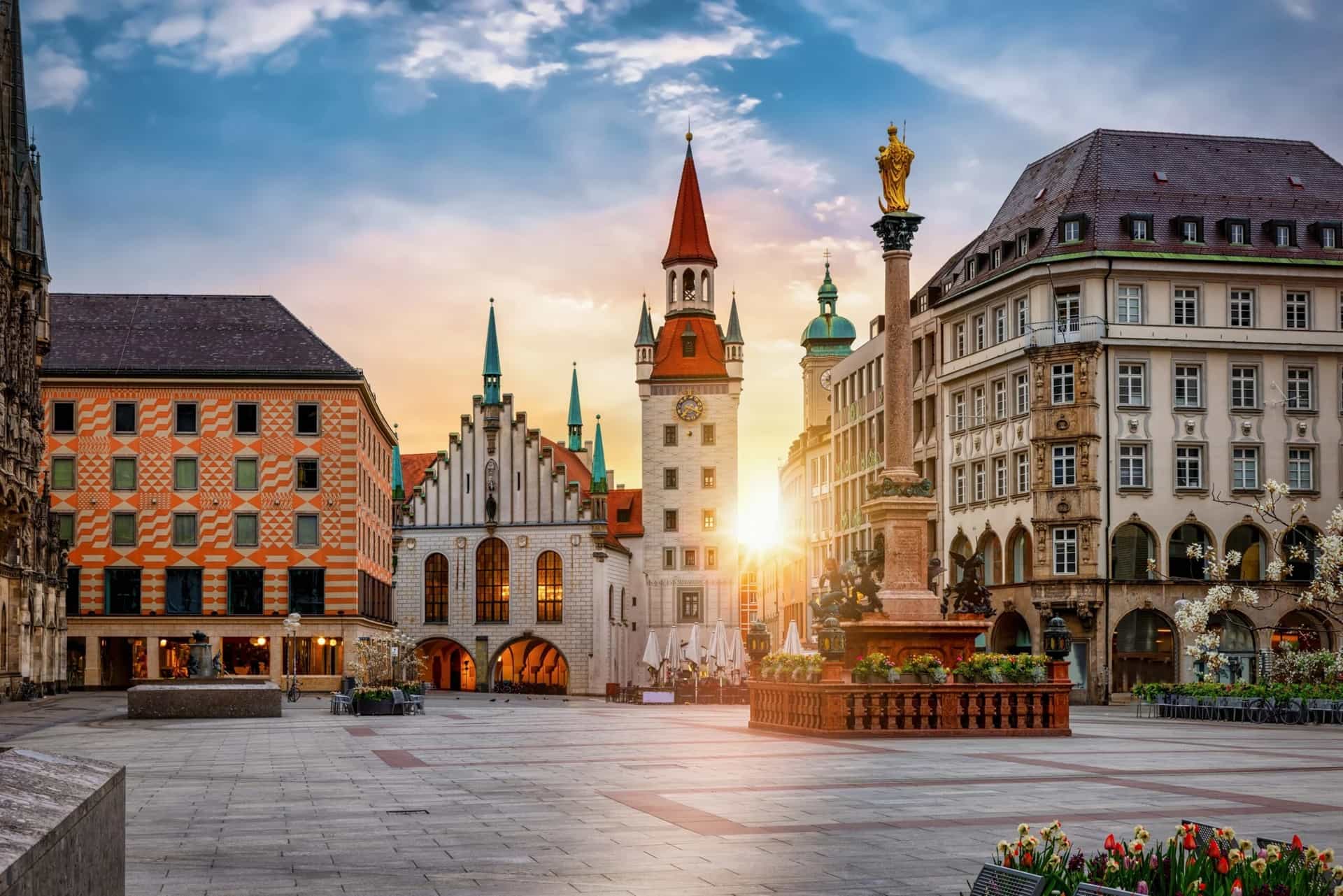
Munich is the capital of Bavaria and the third-largest city in Germany, a place that manages to combine a serious claim to being one of Europe's great cultural capitals with an equally serious commitment to the pleasures of Bavarian food, beer, and outdoor life. The city was shaped over centuries by the Wittelsbach dynasty, whose ambitions as patrons of art, architecture, and music left Munich with an extraordinary legacy of palaces, museums, and public buildings. It is also, of course, the home of Oktoberfest - the annual beer festival held on the Theresienwiese meadow every September and October, which draws over six million visitors and remains one of the largest and most exuberant public events anywhere in the world.
Marienplatz
Marienplatz is the historic heart of Munich, a large pedestrianised square that has served as the city's main gathering place since its founding in 1158. At the centre stands the Mariensäule, a column topped by a golden statue of the Virgin Mary erected in 1638 to mark the city's survival of Swedish occupation and the plague, and it is this column that gives the square its name. The square is flanked by two town halls: the Old Town Hall (Altes Rathaus) on the eastern side, a Gothic building dating from the 15th century that now houses a toy museum, and the much larger New Town Hall (Neues Rathaus) on the northern side, a neo-Gothic structure completed in 1909 whose facade of carved stonework towers above the square. At 11am and noon daily (and also at 5pm in summer), the Glockenspiel carillon in the New Town Hall tower performs a display of 43 bells and 32 life-size figures re-enacting scenes from Munich's history, drawing crowds of visitors to the square below.
Frauenkirche
The twin onion-domed towers of the Frauenkirche (Cathedral of Our Lady) are the defining feature of Munich's skyline and the symbol most closely identified with the city. Construction of the cathedral began in 1468 on the site of an earlier Romanesque church, and the building was completed - though without its now-famous domes, which were added later - in just 20 years, a remarkably short time for a building of its scale. The cathedral serves as the seat of the Archbishop of Munich and Freising and remains an active place of worship. Inside, the brick-vaulted nave is surprisingly spacious and austere compared to the ornate Baroque churches elsewhere in Bavaria, and the late Gothic character of the original building is well preserved. A city ordinance still limits new buildings in the historic centre to the height of the towers - 99 metres - preserving the cathedral's dominance of the skyline after more than five centuries.
Englischer Garten
The Englischer Garten is one of the largest urban parks in the world, stretching for over 9 kilometres through the heart of Munich from the edge of the city centre northward to the city limits. Created in 1789 at the instigation of the American-born statesman Benjamin Thompson, it was designed in the informal English landscape style - hence the name - as a public park open to all citizens, a genuinely radical concept at a time when most European royal parks were restricted to the nobility. Within the park there is a great deal to discover. The Chinese Tower (Chinesischer Turm), a five-storey wooden pagoda built in 1789, is surrounded by Munich's most popular beer garden, which seats up to 7,000 people and is busy on every dry afternoon from spring to autumn. The Greek Monopteros temple on a low hill offers one of the best views over the city. Perhaps most surprisingly, a standing wave created by the flow of the Eisbach stream at the southern entrance to the park has been surfed continuously since the 1970s - watching the surfers ride the same stationary wave in the middle of a landlocked European city is one of Munich's more unexpected pleasures.
Residenz Palace
The Munich Residenz was the official seat and residence of the Wittelsbach dynasty - the rulers of Bavaria - from 1508 until the end of the monarchy in 1918, and the vast complex that accumulated over those four centuries is now the largest city palace in Germany. Comprising ten courtyards and over 130 rooms, the Residenz reflects almost every major architectural style of its long history: Renaissance, Baroque, Rococo, and Neoclassical wings sit alongside each other in a series of spaces that range from intimate private apartments to vast ceremonial halls. The Residenzmuseum, which occupies the historical rooms of the palace, is one of the most important museums in Germany and requires several hours to do justice to. Highlights include the Antiquarium - a barrel-vaulted Renaissance hall decorated with frescoes and busts, the largest Renaissance interior north of the Alps - and the Cuvilliés Theatre, an exquisite Rococo court theatre that survived the Second World War only because its interior fittings had been removed and stored for safekeeping before the bombing began. The Imperial Treasury (Schatzkammer) houses a separate collection of crown jewels, regalia, and decorative art objects.
Nymphenburg Palace
On the western outskirts of Munich, connected to the city centre by a straight canal aligned with the palace's main axis, stands Schloss Nymphenburg - the summer residence of the Bavarian rulers and one of the most impressive Baroque palace complexes in Germany. Construction began in 1664 as a relatively modest summer villa and was expanded continuously over the following century as each successive ruler added new wings, side pavilions, and garden buildings to create the 600-metre-wide facade seen today. The interior includes the famous Gallery of Beauties, commissioned by King Ludwig I, which contains 36 portraits of women considered the most beautiful in Munich during the 1820s and 1830s - one of the more unusual royal commissions of the 19th century. The grounds, which extend to around 200 hectares, contain several small palaces and garden buildings within the formal gardens and the English landscape park beyond, including the Amalienburg, a Rococo hunting lodge whose Hall of Mirrors rivals Versailles for sheer decorative extravagance.
Deutsches Museum
Founded in 1903 and spread across an island in the River Isar, the Deutsches Museum is the world's largest science and technology museum by floor area, with a collection of around 73,000 exhibited objects spanning the full range of human scientific and technological achievement. Everything from early aircraft and historic locomotives to printing presses, astronomical instruments, and models of DNA is represented, and many exhibits are hands-on. Particularly popular areas include the mining section, which includes a reconstructed underground mine visitors can walk through, the aeronautics hall - which contains some of the earliest surviving aircraft alongside space exploration hardware - and the astronomy and planetarium section. A single day is genuinely not enough to see the whole collection, and the museum is well worth prioritising for anyone with an interest in science, engineering, or industrial history.
Viktualienmarkt
Just south of Marienplatz, the Viktualienmarkt has been Munich's main open-air food market since 1807, when it was moved from the increasingly crowded city square to its current location. What began as a simple farmers' market supplying the city with its daily provisions has evolved over two centuries into one of the finest food markets in Germany, with over 100 permanent stalls selling fruit, vegetables, cheese, bread, meat, fish, spices, and an increasingly wide range of international produce. The market is at its liveliest in the morning, when the stalls are freshest and the regular customers - restaurateurs, chefs, and local residents - do their shopping alongside the visitors. At the centre of the market stands a beer garden shaded by maypole and large chestnut trees, open from early afternoon and particularly pleasant on a summer evening. On Shrove Tuesday, the market traders perform a traditional dance around the maypole in their work clothes - one of the more endearing of Munich's seasonal customs.
Hofbräuhaus
The Hofbräuhaus am Platzl is Munich's most famous beer hall and one of the most visited buildings in Bavaria. Founded in 1589 as a royal brewery by Duke Wilhelm V, it became a public beer hall in the 19th century and has been a fixture of Munich's social life ever since. The ground floor hall, with its painted barrel-vaulted ceiling, long communal tables, and resident brass band, accommodates around 1,000 people and operates at close to full capacity on most evenings throughout the year. The beer served is Hofbräu München, brewed to the same broad range of Bavarian styles - Helles, Dunkel, Weissbier, and the seasonal Oktoberfest and Maibock - as it has been for centuries. The Hofbräuhaus occupies one of the largest tents at Oktoberfest and is often the first destination for visitors arriving in Munich for the festival. However good a beer hall it undeniably is, it is also always very busy; for a more local experience, Munich's network of neighbourhood beer gardens and smaller beer halls offers the same quality without the tourist-to-local ratio of the Platzl.